
A few months ago I got a call from a physician who had retired early.
Not a struggling borrower. Not someone with credit problems. A successful doctor with substantial assets and ownership interests in multiple businesses.
He’d been watching a house in his neighborhood for years. It finally hit the market.
Then he went through the traditional mortgage process, and his income looked complicated. Multiple businesses. K-1 income. Ownership interests. Distributions. Tax returns that told a technically accurate story and a practically useless one.
On paper, he looked far less qualified than he actually was.
A bank turned him down.
Here’s the part most people don’t expect: we got him approved using almost none of the income everyone had spent weeks arguing about. We qualified him on his assets instead – his retirement and investment accounts – without selling a single share.
This post walks through exactly how that works, what the math actually looks like, and who it’s for.
Why the Highest Earners Are Often the Hardest to Approve
Most people assume mortgage qualification is straightforward. You make money, you document it, you get approved.
That’s mostly true if you’re a W-2 employee. It gets less true the more successful you become.
Maybe you own a business. Maybe you receive K-1 income. Maybe your CPA is doing exactly what you hired them to do and minimizing your taxable income. Maybe you own several businesses. Maybe you hold substantial investments and borrow against them rather than drawing taxable income at all.
Every one of those is a sign of financial sophistication. Every one of them makes a mortgage file harder.
The irony is hard to miss: a borrower with a $100,000 W-2 job is often easier to approve than someone with several million dollars sitting in the accounts their financial planner spent a decade building.
This is where a lot of banks hit a wall. A bank has a limited menu. If you fit inside the box, terrific. If you don’t fit inside the box, the answer is usually just “no”. Not because you’re unqualified, but because they don’t have anything else to offer you.
A broker approaches it from the other direction.
A bank asks: does this borrower fit this loan?
I ask: which loan fits this borrower?
That’s not a slogan. It’s a completely different starting question, and it produces completely different answers.
What Is an Asset Depletion Mortgage?
An asset depletion mortgage lets you qualify using the assets you already have instead of your monthly income. The lender totals your eligible accounts – retirement, brokerage, savings – applies a percentage, and divides the result by a set number of months to produce a monthly qualifying income figure. Nothing is sold, spent, or restricted.
That last sentence matters, so let me be blunt about it: you are not liquidating your assets.
Here’s the logic underwriting is actually applying. They’re not asking you to spend your savings. They’re asking a hypothetical: if the worst case happened – if the income stopped – could this borrower cover the mortgage from what they already have?
If the answer is yes, they’re willing to take your word that you can make the payment. The assets are the backstop, not the source.
Once you understand it that way, asset depletion stops sounding exotic and starts sounding like what it is – a different way of answering the same question every lender asks.
How Asset Depletion Income Is Actually Calculated
Most articles on this topic define the term and stop. Here’s the math.
Important caveat, and I mean it: the numbers below come from one specific loan program with one specific lender on one specific file. Asset depletion guidelines vary significantly between lenders and programs, and they change. Treat this as an illustration of the mechanics, not a formula you can apply to your own accounts. Your actual numbers require an actual conversation.
With that said, here’s how it worked on my client’s file.
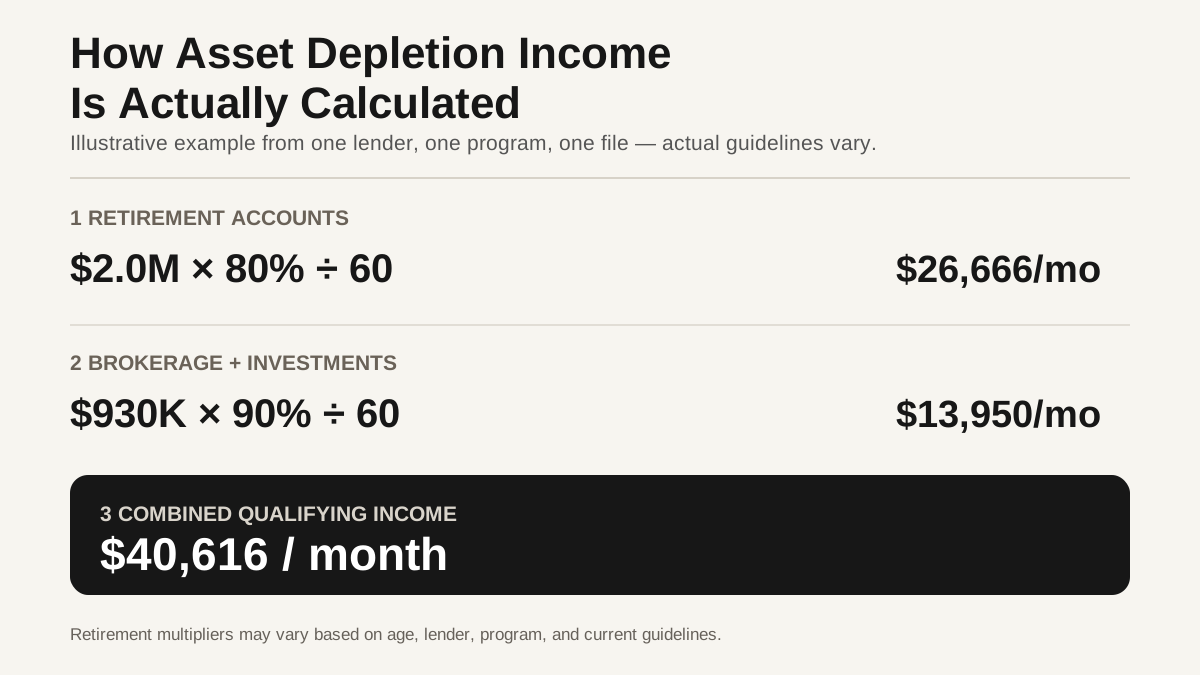
Step one – retirement accounts. We totaled his retirement accounts, multiplied by 80%, then divided by 60.
Using rounded numbers for illustration, let’s say he had $2,000,000 in retirement accounts:
- $2,000,000 × 80% = $1,600,000
- $1,600,000 ÷ 60 = $26,666 per month in qualifying income
Step two – brokerage and investment accounts. Same process, but these get a more favorable multiplier. Instead of 80%, we used 90%.
He had just over $930,000 in brokerage and investment accounts:
- $930,000 × 90% = $837,000
- $837,000 ÷ 60 = $13,950 per month
Step three – add them together. Combined, his assets produced $40,616 per month in qualifying income.
He had some existing debts, which is why we needed the second layer. But once we got there, the file worked. No liquidation. No selling at a bad moment. No touching the accounts at all.
One note on that 80%. The percentage applied to retirement accounts depends partly on the borrower’s age. Because this client was younger and still a ways from retirement age, those funds got treated more conservatively – money you can’t access yet without a penalty doesn’t get counted as generously as money you can reach today. A borrower closer to retirement age would likely have seen a higher percentage on the same balance.
This example is for educational purposes only and reflects guidelines applicable to a specific loan program and borrower scenario at the time of origination. Loan programs, eligibility requirements, asset calculations, rates, terms and underwriting guidelines vary by lender and are subject to change. This is not a commitment to lend. All loans are subject to credit approval.
Asset Depletion on a Traditional Loan vs. an Asset Depletion Loan
This distinction gets missed constantly, and it’s the whole point.
Asset depletion isn’t exclusively a broker product. You can sometimes fold asset-based income into a traditional mortgage – but only in narrow circumstances, as a supplement to income you’re already documenting.
The real tool is the asset depletion loan, where assets aren’t supplementing your income calculation. They are the income calculation. No wrestling with K-1s. No reconciling distributions across four entities. No third round of underwriting conditions asking you to explain a transfer between two accounts you own.
That’s the version most banks and credit unions simply don’t have on the shelf.
What Asset Depletion Is Not
Before anyone jumps to conclusions:
- You are not spending your savings. The accounts stay where they are.
- You are not liquidating investments. Nothing gets sold.
- Your accounts aren’t frozen or pledged. You retain full control.
- It isn’t available on every program. This is a specific product, not a universal option.
This Is About Income – Not Cash to Close
Worth being precise here, because “we’re not liquidating your assets” is true in a specific way and I don’t want it to mean something it doesn’t.
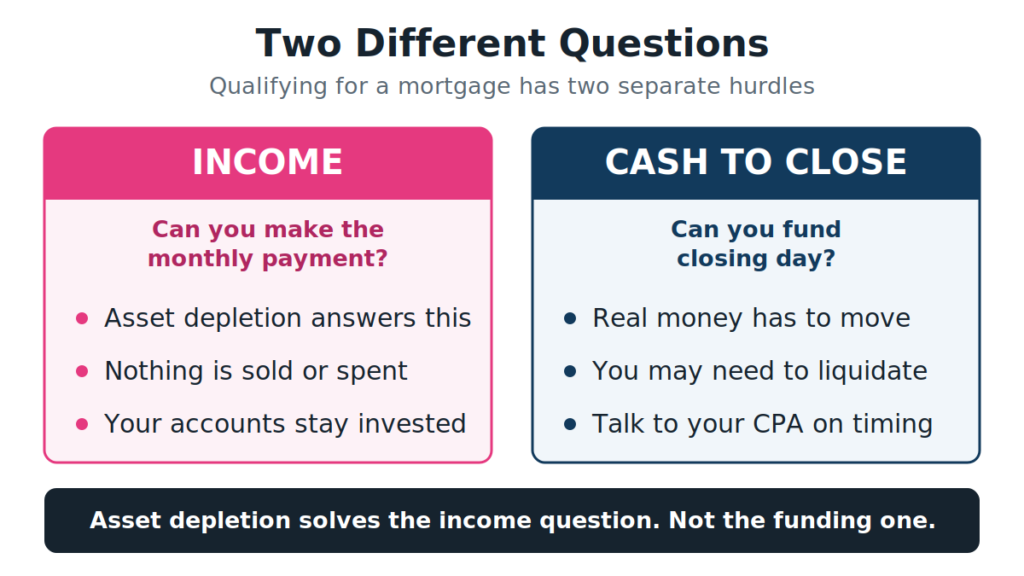
Qualifying for a mortgage has two separate hurdles, and people collapse them into one all the time.
The first is income. Can you support the monthly payment? That’s what debt-to-income ratios measure, and that’s the question asset depletion answers. When I say nothing gets liquidated, this is what I mean – your accounts are not touched to generate the qualifying income. The lender is running a calculation, not a transaction.
The second hurdle is cash to close. That’s the actual money that has to hit the title company’s account on closing day – your down payment, closing costs, prepaid taxes and insurance, minus your earnest money and any credits. That money has to be real, and it has to move.
Asset depletion does nothing for that second one.
So yes – you may absolutely need to liquidate something to fund your closing. If your cash to close is $180,000 and it’s sitting in a brokerage account, it has to become cash in a bank account before closing day. That’s a sale, and depending on what you sell and when, it may carry a tax consequence worth talking to your CPA about before you list the house, not after you’re under contract.
There’s one more wrinkle that catches people. On many programs, the assets you use to fund closing don’t also count toward your depletion calculation. You can’t spend the same dollar twice. If you’re planning to pull $200,000 out of a brokerage account for the down payment, the qualifying income gets calculated on what’s left – plus whatever reserves the program requires you to keep. That’s a question worth asking early, because it can change which accounts you use for what.
None of this makes asset depletion less useful. It just means it solves the income problem, not the funding problem. Those are two different conversations and they both need to happen.
(If cash to close is the part that’s fuzzy for you, I broke that number down in detail here.)
Who This Actually Works For
Asset depletion is worth a conversation if you’re:
- A physician or other high-earning professional
- A business owner or entrepreneur
- A retiree living on savings and distributions
- An investor with significant holdings
- Anyone borrowing against assets rather than drawing taxable income
- Anyone whose tax returns don’t reflect their actual financial strength
It isn’t right for everyone. But if you’ve ever looked at your own balance sheet and thought “I have plenty of money – why is this so hard?”, this is probably the conversation you haven’t had yet.
I see this constantly with retirees relocating to Arizona. Strong balance sheet, modest taxable income, and a bank that can’t figure out how to say yes.
If Asset Depletion Isn’t the Right Fit
Asset depletion is one tool. It isn’t the only one.
If you’re self-employed and your write-offs have shrunk your qualifying income, a bank statement loan may be the better path – those qualify on deposits rather than tax returns. If you’re buying investment property, DSCR financing qualifies the property on its own rental income instead of qualifying you. There are other Non-QM options built for income that doesn’t fit a standard box.
The specific product matters less than having access to the whole menu.
I’ll cover the self-employed side in detail in an upcoming post – how underwriters actually calculate self-employed income, and which write-offs cost you the most qualifying power.
The Takeaway
The biggest takeaway here isn’t asset depletion.
It’s that there is more than one way to qualify for a mortgage.
When you’re working with a lender who only offers one solution, every problem starts to look impossible. As a broker, I have access to dozens of lenders and hundreds of programs. Sometimes the difference between an approval and a denial isn’t your finances at all.
It’s the strategy. And the person building it.
If you’ve been told no, if your income is complicated, or if you’re not sure how your situation fits into traditional lending – reach out. Let’s look at the whole picture.
You may be a lot closer to buying that house than you’ve been led to believe.
Frequently Asked Questions
What is an asset depletion mortgage? An asset depletion mortgage lets you qualify using your existing assets rather than your monthly income. The lender totals eligible accounts, applies a percentage, and divides by a set number of months to arrive at a monthly qualifying income figure. Your assets are never sold or spent.
Do I have to sell my investments to use asset depletion? No. Nothing is liquidated. Underwriting is confirming that you could cover the payment from your assets if your income stopped – the accounts themselves stay untouched and under your control.
Can I use my 401(k) or IRA to qualify for a mortgage? Often yes. Retirement accounts are commonly eligible, though they’re typically discounted more heavily than taxable brokerage accounts, and the applicable percentage can depend on your age and your access to the funds.
How much monthly income can my assets generate? It depends on the account types, the balances, and the specific program. On the file described above, a combined portfolio produced just over $40,000 per month in qualifying income – but the multipliers and divisors vary by lender and change over time.
Do banks offer asset depletion loans? Some banks allow limited asset-based income within a traditional loan. True asset depletion loans, where assets are the sole qualifying method, are generally only available through brokers with access to Non-QM lenders.
Is the rate higher on an asset depletion loan? Usually somewhat, since these are Non-QM products. Whether that premium is worth it depends on the alternative – and for many borrowers, the alternative is not getting approved at all.
Can I combine asset depletion with regular income? Sometimes, depending on the program. Some allow assets to supplement documented income; others use assets exclusively. Which structure works better is part of what gets figured out up front.
This is not a commitment to lend. All loans are subject to credit approval. Program guidelines vary by lender and are subject to change.